Is sparkling water acidic? The measured numbers, and what they mean for your teeth
We sell water ionizers, machines marketed largely on making water more alkaline. This post is about water going the other way, so weigh what follows with that in mind. We would rather say it in the first line than bury it at the bottom.
Is sparkling water acidic? Yes, mildly. Plain sparkling water is more acidic than still water, but much less acidic than soda, juice, or flavored fizzy drinks. Below: why the bubbles lower the pH, the measured numbers for real products, what the tooth studies actually tested, and the one claim our own industry gets backwards.

Is sparkling water acidic? Why the bubbles lower the pH
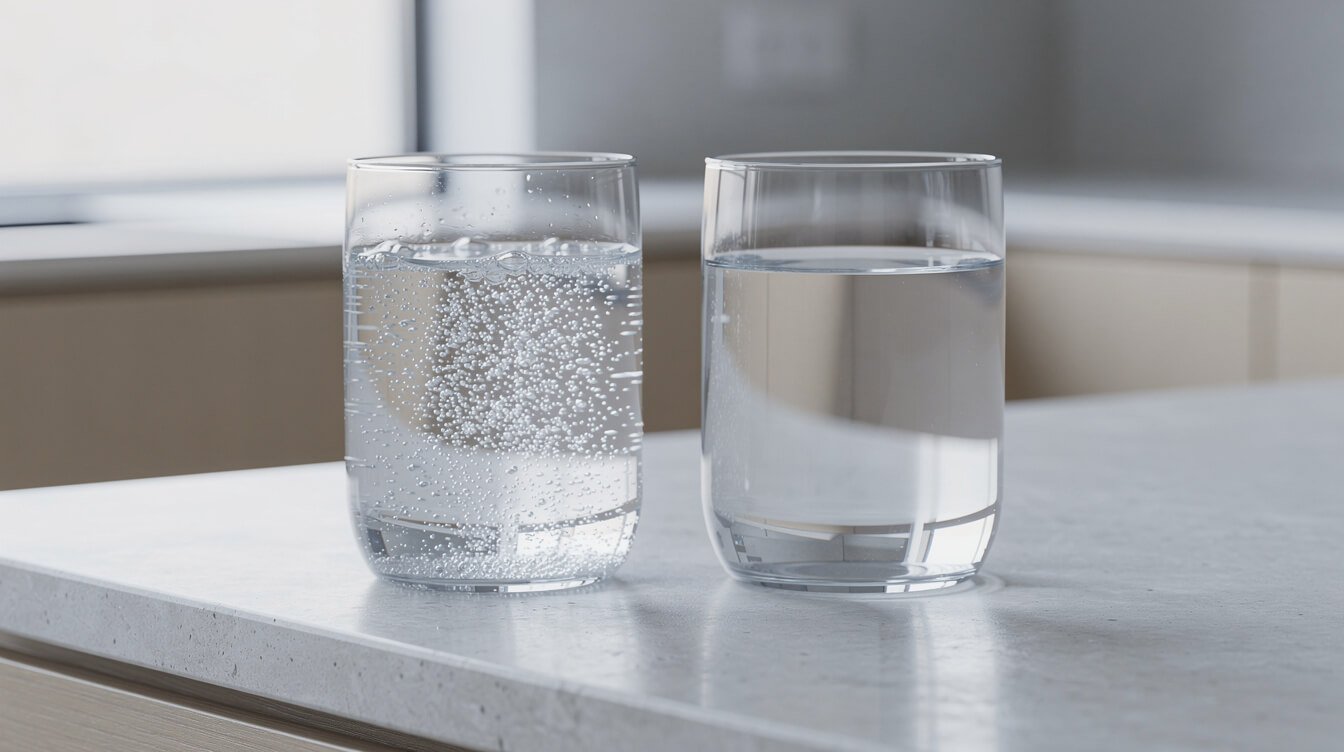
The fizz is carbon dioxide (CO2). When CO2 dissolves in water, a small share of it reacts with the water to form carbonic acid, a weak acid. That acid releases hydrogen ions, and more hydrogen ions means a lower pH.
This happens even without a soda machine. The U.S. Geological Survey’s field manual for measuring pH (2021) notes that pure water left in contact with ordinary air at 25 °C settles at pH 5.7, purely because of CO2 from the atmosphere. Sparkling water is the same chemistry, with far more gas forced in under pressure.
Two things follow from that. First, the acid leaves with the gas: as a glass goes flat, CO2 escapes and the pH drifts back up. Second, the starting water matters. Dissolved minerals such as bicarbonate absorb some of the acid, which is one reason two sparkling waters can read differently.
The same gas loss is why a pH reading of carbonated water depends on when you take it. If you want to measure a glass yourself, our guide to testing water pH at home covers which methods are good enough for which question.
How acidic is sparkling water? The measured numbers
The most useful data set is a 2016 study in the Journal of the American Dental Association (Reddy et al.). The researchers bought 379 beverages in Birmingham, Alabama, and measured each with a pH meter, in triplicate, at 25 °C, immediately after opening. A selection:
| Drink (as measured in the 2016 study) | pH |
|---|---|
| Birmingham municipal tap water | 7.20 |
| Perrier carbonated mineral water | 5.25 |
| Canada Dry club soda | 5.24 |
| S. Pellegrino sparkling natural mineral water | 4.96 |
| Juicy Juice Sparkling (apple, berry, orange) | 3.47 to 3.50 |
| Izze Sparkling (blackberry, clementine, pomegranate) | 3.01 to 3.28 |
| Coca-Cola Classic | 2.37 |
Formulas change, so treat these as 2016 measurements, not current labels. The pattern is what matters. Plain sparkling waters landed around pH 5. Sparkling drinks with fruit or flavor landed around pH 3 to 3.5, and cola lower still. Because the pH scale is logarithmic, a drink at pH 3 has a hundred times the hydrogen ion concentration of one at pH 5. “Sparkling water” and “sparkling drink” are not the same thing, even when they sit on the same shelf.
The study also grouped drinks by erosive potential: below pH 3.0 “extremely erosive,” 3.0 to 3.99 “erosive,” and 4.0 or above “minimally erosive.” So is sparkling water acidic enough to count as erosive by that scale? Plain sparkling water sits in the last group. The authors also note that enamel starts to demineralize below about pH 5.5, so plain sparkling water is not neutral for teeth, just far milder than most of what is sold beside it.
What the tooth studies actually tested
Many articles on this topic, several of them from dental practices, go straight to “sparkling water erodes enamel.” The two studies usually behind that sentence say something narrower, and both were done in a laboratory, not in people.
Parry et al., 2001 (Journal of Oral Rehabilitation) was in vitro: extracted human teeth and powdered tooth mineral in a dish. Sparkling mineral waters dissolved slightly more than still waters, but roughly a hundred times less than the soft drinks tested. Removing the gas reduced dissolution further, and the authors concluded that carbonation “may not be an important factor per se.”
Brown et al., 2007 (International Journal of Paediatric Dentistry), from the same Birmingham dental school, was also in vitro. It tested flavored sparkling waters from the UK market. They measured pH 2.74 to 3.34 and were as erosive as pure orange juice, or more so. The authors advised treating them as acidic drinks rather than as water with flavoring.
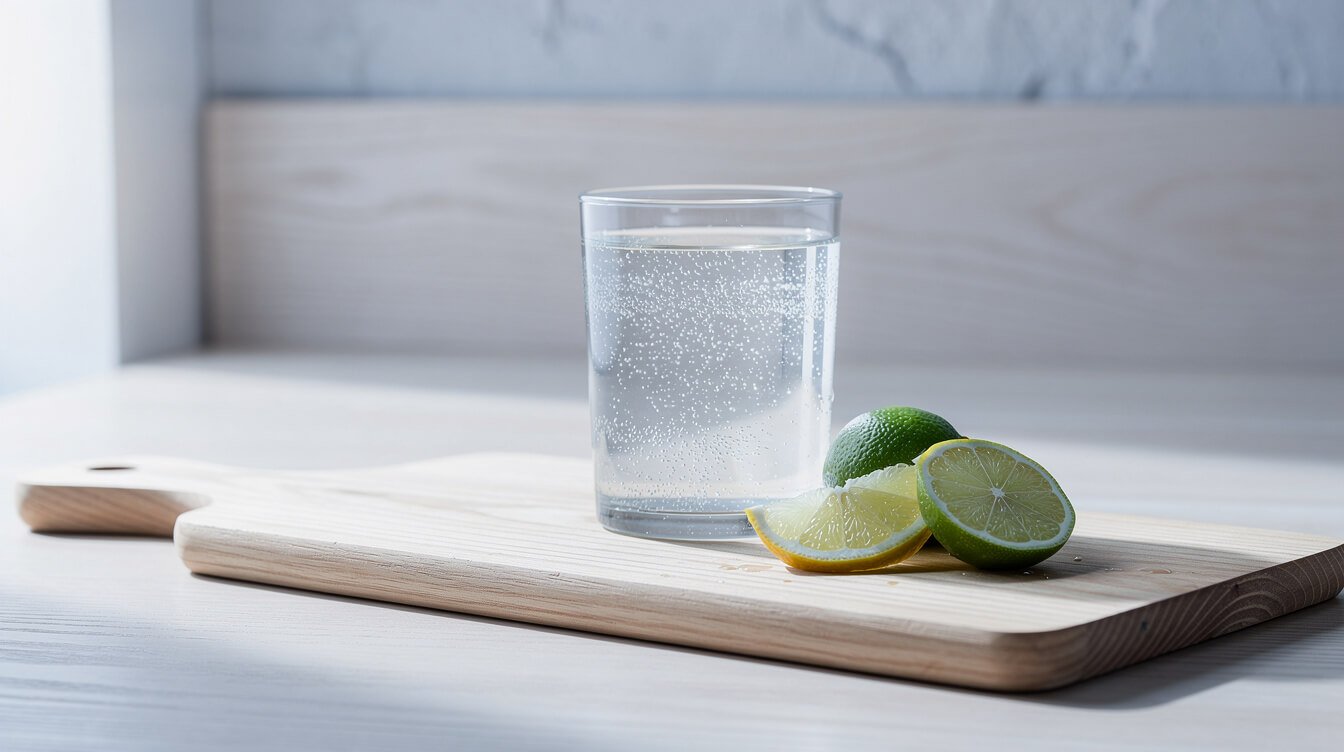
Read together, the bubbles are a small factor and the added fruit acid is the big one. Reddy’s paper adds a detail worth knowing: citrate can contribute to erosion even at higher pH. A dish of tooth powder also has no saliva, no swallowing, and no time between sips, so none of this tells you what happens in a particular mouth. If you already have enamel erosion, that is a question for your dentist.
Does acidic water make your body acidic?
No. This is the mirror image of the claim our own industry has made for years about alkaline water, and it is wrong in both directions. Your blood pH is held in a narrow range by your lungs and kidneys, whatever you drink. Stomach acid is far more acidic than any sparkling water. Our post on the pH of water covers that in more detail.
A glass of seltzer will not acidify you, any more than an alkaline glass will alkalize you. If someone tells you to avoid sparkling water because it makes your body acidic, they are using the same myth we spend much of this blog correcting.
Honest answers, weekly
The research, without the sales pitch
One short email a week: what a study actually found, what it didn't, and what's worth your attention. No spam. Unsubscribe anytime.
Does sparkling water hydrate as well as still water?
On the one human trial we found, yes. Maughan et al., 2016 (American Journal of Clinical Nutrition) was a randomized trial in 72 healthy, fasted men. Each drank 1 liter of still water or one of several other drinks, and researchers collected their urine for 4 hours. Urine output after sparkling water was not different from still water.
The limits matter: men only, already hydrated, one sitting, one brand of plain sparkling water. The trial was funded by the European Hydration Institute, and the lead author chaired its scientific advisory board. Within those limits, carbonation did not make water less hydrating.
Who might want to go easy on it
- Anyone drinking flavored sparkling water all day. Check the ingredient list for added acids such as citric acid. On the evidence above, that matters more than the bubbles.
- People with existing enamel erosion or sensitivity. Ask your dentist. The studies here can’t answer that for you.
- People with reflux. That’s a conversation for your doctor. Our post on water and acid reflux covers what the research does and doesn’t show.
- Anyone who gets bloated. The dissolved gas has to go somewhere. If fizzy water leaves you uncomfortable, still water does the same hydrating job.
If you are comparing waters
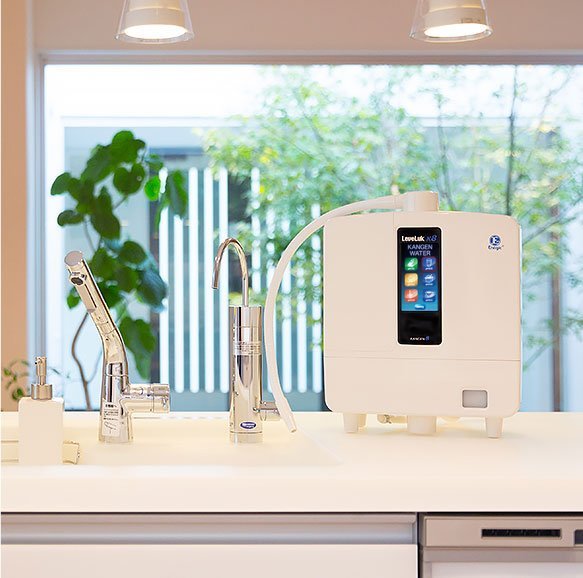
The LeveLuk K8 is the eight-plate ionizer we sell. It filters your tap water and adjusts pH by electrolysis as you pour. It does not carbonate water, and it is not a remedy for anything in this post. Specs and documentation are on the product page.
So, is sparkling water acidic enough to worry about?
For most people drinking plain sparkling water, the measured answer is no. It is mildly acidic, around pH 5 in the 2016 measurements. Flavored sparkling drinks measured roughly 30 to 100 times more acidic, and cola more acidic still. In the one human trial we found, it hydrated like still water, and it does nothing to your body’s pH.
The honest caveats are the ones above. The enamel evidence is laboratory work, flavored versions behave like acidic drinks, and anyone with erosion, reflux, or discomfort should ask a professional rather than a blog. To see where your own water sits, our post on what pH drinking water should be is a good next read.
This article is for general information and is not medical advice. Talk to your doctor before changing what you drink, especially if you have kidney disease, are pregnant, or take medication.
Before you go
Get the next honest answer by email
We'd rather tell you when the answer is no. One email a week, written the same way as this post.