Microplastics in bottled water: what the counts mean, and what regulators say
We sell water ionizers, which filter tap water, so we have a commercial interest in whether you keep buying bottled water. Weigh what follows with that in mind. We would rather say it in the first line than bury it.
Microplastics in bottled water is one of those topics where the headline numbers are real and still easy to misread. One study counted about 325 particles per liter. A later one counted about 240,000. Both can be right. Here is what each one measured, where the plastic seems to come from, and what the FDA and the World Health Organization say about risk. We also cover the few things you can actually do about it.
Microplastics in bottled water: what the studies counted
The study most articles still quote is Mason, Welch, and Neratko, published in Frontiers in Chemistry in 2018. The team tested 259 bottles of 11 brands, bought in 19 locations across nine countries. They stained the samples with a dye (Nile Red) that sticks to plastic, then counted what glowed.
- 93% of bottles showed some sign of microplastic contamination.
- After subtracting likely lab contamination, bottles averaged 10.4 particles per liter larger than 100 micrometers.
- Counting smaller particles down to 6.5 micrometers raised the average to 325 per liter. The authors note these smaller ones could not be confirmed as plastic by spectroscopy, only by the dye.
- Individual bottles ranged from zero to over 10,000 particles per liter.
The second study is Qian and colleagues at Columbia University, published in PNAS in January 2024. Its main contribution was a new imaging method (stimulated Raman scattering microscopy) that can identify single plastic particles below 100 nanometers. Applied to bottled water, it estimated about 240,000 particles per liter (plus or minus 130,000), and about 90% of those were nanoplastics. The authors call this “orders of magnitude more than the microplastic abundance reported previously in bottled water.”
Why the counts differ by a factor of hundreds
The two studies were mostly looking at different things. Mason’s method stopped at 6.5 micrometers. Qian’s reached far below one micrometer, into the nanoplastic range. Small particles vastly outnumber large ones, so a method that sees smaller particles will always report a bigger number. The jump from 325 to 240,000 is mainly a jump in what the instrument could see, not proof that bottled water got worse between 2018 and 2024.
For scale, the FDA describes microplastics as typically under five millimeters and nanoplastics as under one micrometer, and notes that a human hair is about 70 micrometers across. It also says there are “currently no standard definitions” for either size class.
Two more cautions apply to every count you see:
- A count is not a dose. Particles per liter says nothing about their total mass, what polymer they are, or whether they are absorbed.
- Methods are not standardized. The FDA’s review says many studies “have used methods of variable, questionable, and/or limited accuracy and specificity.” Results from different labs are hard to compare.
This is the same trap as treating a TDS meter reading as a safety score: a number is only meaningful once you know what the instrument counts.
Where the plastic in the bottle comes from
Mason’s team found that polypropylene was the most common polymer among the particles they could identify (54%). They point out that this “matches a common plastic used for the manufacture of bottle caps,” and conclude that the contamination is “at least partially coming from the packaging and/or the bottling process itself.”
The FDA reads the wider evidence more cautiously. It says there is “not sufficient scientific evidence to show that microplastics and nanoplastics from plastic food packaging migrate into foods and beverages,” and that microplastics enter food “primarily through the environment.” We report both views because they don’t fully agree, and the honest position is that the source question is not settled.
What is settled is that bottled water is not the only route. The FDA notes that microplastics have been found in both tap and bottled water, and in foods from salt and seafood to honey, milk, and tea. Switching from bottled to tap removes one possible source, the bottle. It does not take your exposure to zero.
Honest answers, weekly
The research, without the sales pitch
One short email a week: what a study actually found, what it didn't, and what's worth your attention. No spam. Unsubscribe anytime.
What regulators say about the risk
The plain answer is that nobody knows yet, and the agencies say so.
- FDA (food and bottled water): “current scientific evidence does not demonstrate that levels of microplastics or nanoplastics detected in foods pose a risk to human health.” It adds that particles have been found in human samples, including blood and organs, and that “there is not enough known about their potential health effects.”
- WHO (2019 analysis of drinking water): based on “the limited information we have, microplastics in drinking water don’t appear to pose a health risk at current levels. But we need to find out more.” The WHO also says particles larger than 150 micrometers are not likely to be absorbed and uptake of smaller ones is expected to be limited. Absorption of nano-sized particles may be higher, “although the data is extremely limited.”
- No US limit exists. The FDA notes that the EPA sets limits for tap water but “there currently are no regulatory levels set for microplastics or nanoplastics in drinking water.” Neither bottled nor tap water has a microplastics standard to fail.
California has gone furthest on measurement. A 2018 state law required its State Water Resources Control Board to define microplastics in drinking water, which it adopted in 2020. The board published standardized testing methods in 2021, and its staff have proposed a four-year testing and public reporting program. That program covers drinking water systems, not bottled water.
Notice the timing of the FDA and WHO statements, too. The WHO statement predates the 2024 nanoplastics study, and both agencies say the evidence on the smallest particles is thin. “No demonstrated risk” here means the research hasn’t answered the question, not that someone showed the particles are harmless.
What you can reasonably do about it
If you want less plastic in what you drink, these steps are supported by the sources above, in rough order of how much they change:
- Drink tap water if your tap is good. That removes the bottle and cap from the picture. Before switching, check what’s actually in your tap. Our guide on how to find out if your tap water is safe covers the annual water quality report and lead service lines.
- If you filter, check the claim. If a filter says it reduces microplastics, ask which certification standard it was tested to and what particle size the claim covers. Then confirm it in the certifier’s own listing, not just on the box. The same habit applies to fluoride filter claims.
- Don’t trade a known risk for an unknown one. WHO advises water suppliers to prioritize pathogens and chemicals that are known risks. If you drink bottled water because your tap has a known problem such as lead, a microplastics headline is not a reason to switch back.
Who should not change anything on our account
If bottled water is how you get safe water during a boil notice, after a lead result, or on a private well you haven’t tested, keep using it. And don’t buy a water machine because of this article. The evidence on health effects is not strong enough to justify a purchase on that basis.
If you drink tap water for taste
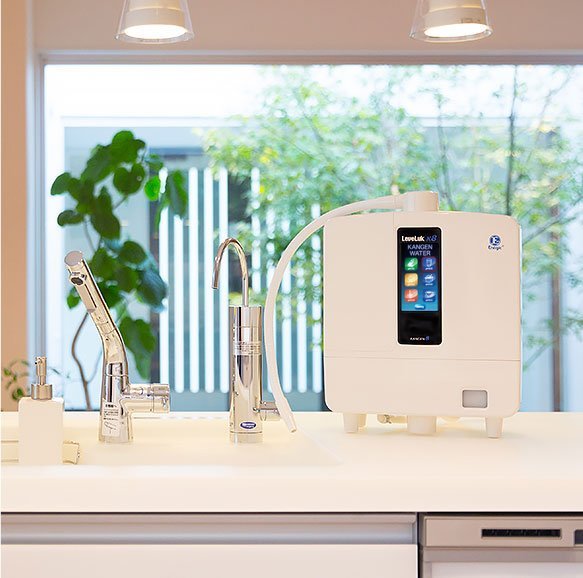
The LeveLuk K8 is the eight-plate water ionizer we sell. It filters tap water at the faucet. Its listing makes no microplastic-reduction claim, so do not buy it for that. Specs are on the product page.
The bottom line on microplastics in bottled water
Bottled water contains plastic particles. How many depends mostly on how small a particle the lab can see: about 325 per liter with 2018 methods, and about 240,000 per liter once nanoplastics were counted in 2024. Some of it likely comes from the cap and bottling process, though the FDA says migration from packaging isn’t established. Neither the FDA nor the WHO has found a demonstrated health risk, and both say the evidence is limited, especially for the smallest particles. If a good tap is available to you, drinking from it is the simplest way to take the bottle out of the equation.
This article is for general information and is not medical advice. Study findings and regulatory references are current as of November 22, 2026, and may change. If you have a health concern, talk to your doctor. For questions about your tap water, contact your water utility or state health department.
Before you go
Get the next honest answer by email
We'd rather tell you when the answer is no. One email a week, written the same way as this post.