Hypochlorous acid generator: what it makes, what the label can claim, and what to check before you buy
We sell water ionizers, which run on the same kind of electrolysis as the devices in this post, though we do not sell hypochlorous acid generators. Weigh what follows with that in mind. We would rather say it in the first line than bury it at the bottom.
A hypochlorous acid generator is a small electrolysis cell that turns salt and water into a dilute chlorine solution. What is actually in your spray bottle depends on things most listings never mention. This post covers the chemistry, what the label is and isn’t allowed to claim, and what to check before you buy. It makes no claim that any particular unit kills anything.
What a hypochlorous acid generator actually makes
You add water and salt, and a current runs between two electrodes. At the positive electrode (the anode), chloride from the salt is oxidized to chlorine. That chlorine reacts with water immediately. The WHO’s background document on chlorine in drinking-water describes the result: “In water, chlorine reacts to form hypochlorous acid and hypochlorites. All three species exist in equilibrium with each other, the relative amounts varying with the pH.”
So the product is a member of the same chemical family as household bleach, which is sodium hypochlorite. The CDC puts household bleach at 5.25% to 6.15% sodium hypochlorite. A countertop generator makes something far more dilute, and the pH of that dilute solution decides which form of chlorine dominates.
The CDC’s guideline on disinfection in healthcare facilities discusses electrolyzed saline (“superoxidized water”) and notes that the professional equipment “can be expensive because parameters such as pH, current, and redox potential must be closely monitored.”
pH decides what is in the bottle
Hypochlorous acid (HOCl) and the hypochlorite ion (OCl⁻) trade places as pH changes. The WHO document gives the crossover: their concentrations “are approximately equal at pH 7.5 and 25 °C.” Below that, hypochlorous acid makes up more of the mix. Above it, hypochlorite does.
That matters because the two forms don’t behave the same way. In the CDC’s words, the microbicidal activity of chlorine “is attributed largely to undissociated hypochlorous acid,” and its efficacy “decreases with an increase in pH that parallels the conversion” to hypochlorite. That is chlorine chemistry in general, not a finding about any specific generator.
At the acidic end there is a different change. The WHO notes that “at pH levels above 4.0, very little molecular chlorine exists in solution.” Push the pH down past that, and chlorine gas becomes part of the picture.
The practical point for a buyer: a “ppm” figure alone does not tell you how much of the solution is hypochlorous acid. Ask for the pH of the output as well. Test kits report it as free chlorine, which is hypochlorous acid plus hypochlorite combined. Our guide to chlorine tests explains free versus total chlorine. If you test a generator’s output, use a kit whose range covers the concentration the seller claims. Many kits are built for drinking water, which carries far less.
What a hypochlorous acid generator label is allowed to claim
In the US, germ-killing claims fall under the EPA’s pesticide law, FIFRA, and the EPA sorts products into two groups.
Registered pesticide products, including disinfectants, go through what the EPA calls “a premarket review of the product.” Their labels carry an EPA Registration Number, and the EPA says these products “undergo a thorough review of data supporting the registration, including product performance (efficacy) studies.”
Devices are different. The EPA’s consumer guide (read November 15, 2026) says “FIFRA does not require registration of devices” and that “generally, device manufacturers, sellers, and distributors do not submit their claims or efficacy and safety data to EPA.” A device label carries an EPA Establishment Number, which identifies the factory. In the EPA’s words, that number “does NOT indicate that the product has been reviewed for safety or efficacy by EPA.”
Where does a generator fall? The same guide says “an apparatus sold with a substance (e.g., salt) that is used to generate a pesticide” is generally a pesticide, not a device. A generator sold without salt is generally treated as a device. The packaging can change the category.
State regulators have noticed the gap. A 2019 issue paper from the North Carolina Department of Agriculture and Consumer Services described generator websites making disinfection claims “without validated data to prove efficacy.” It also flagged literature that inaccurately cited EPA establishment numbers alongside product registration numbers.
So read the label for which number it carries. A germ-killing claim next to an Establishment Number alone is the seller’s claim, not one the EPA has reviewed.
Honest answers, weekly
The research, without the sales pitch
One short email a week: what a study actually found, what it didn't, and what's worth your attention. No spam. Unsubscribe anytime.
Storage, mixing, and the cautions sellers leave out
Homemade chlorine solutions lose strength, and storage changes how fast. Two laboratory studies (not human studies, and not of consumer generators) are worth knowing.
- Len and colleagues (2002, Journal of Agricultural and Food Chemistry) stored electrolyzed oxidizing water under different conditions. In open containers, chlorine was lost through evaporation, and agitation raised the rate of loss “about 5-fold.” In closed containers, diffused light had a larger effect than agitation after two months. Loss fell sharply as pH rose from 2.5 to 9.0.
- Nisola and colleagues (2011, Journal of Environmental Science and Health, Part A) found that stored samples lost activity along with their free chlorine. They found closed vessels kept losses down, and the more acidic, chlorine-gas-rich water lost free chlorine faster than the near-neutral kind.
So make small batches, keep them closed and out of the light, and date them. The cautions matter more:
- Never mix it with acids or ammonia. The CDC lists “release of toxic chlorine gas when mixed with ammonia or acid” among the hazards of hypochlorites. If any instructions suggest adding vinegar to lower the pH, remember the WHO line above: as pH drops toward 4 and below, molecular chlorine reappears.
- Clean first. The CDC notes hypochlorites are inactivated by organic matter, so a dirty surface uses up the chlorine.
- Metals. The CDC lists corrosiveness to metals at high concentrations (above 500 ppm) as a disadvantage.
- Not for drinking, and not covered here for skin, eyes, or wounds. Products sold for those uses are a separate category, and this post does not cover them.
Who should skip a generator: anyone who needs a disinfectant with reviewed efficacy. For example, a care team may have told you how to disinfect surfaces at home. In that case, buy an EPA-registered product and follow its label.
How an ionizer’s acidic stream compares
A water ionizer splits its output at a membrane. The anode side comes out acidic, and if the source water contains chloride, some of it can be oxidized there too. See what a water ionizer actually is for how the cell works.
Enagic labels the strongest acidic setting on its machines, Strong Acidic Water at pH 2.5 or lower, for cleaning surfaces and says it is not intended for drinking. Our post on what Kangen water is quotes that label in full. We make no disinfection claim for that setting, and an ionizer is not sold here as a hypochlorous acid generator.
If you came here for drinking water, not a spray bottle
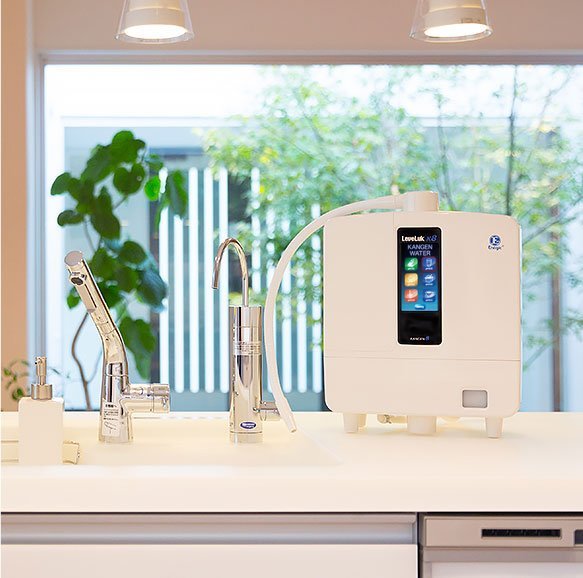
The LeveLuk K8 is the eight-plate ionizer we sell. It filters tap water and makes alkaline water for drinking, plus acidic settings Enagic labels for cleaning. It is not a hypochlorous acid generator, and we make no disinfection claim for it. Specs are on the product page.
Before you buy a hypochlorous acid generator: a short checklist
- Does the listing give the output pH, not just a ppm figure? Without pH you can’t tell how much of the chlorine is hypochlorous acid.
- Which EPA number is on the box? A Registration Number means the EPA reviewed efficacy data. An Establishment Number alone means it did not.
- Is salt sold with it? Under the EPA’s guide, that can change how the product is regulated.
- Can you check the output yourself? A free chlorine test in the right range tells you whether the batch matches the claim.
- Do the instructions ever tell you to add an acid? If so, re-read the CDC’s chlorine gas warning before you do.
A hypochlorous acid generator does real, unmysterious chemistry: salt, current, and a pH-dependent mix of hypochlorous acid and hypochlorite. What the box usually can’t tell you is how strong your batch is, at what pH, and whether anyone reviewed the germ-killing claim. Check the EPA number, test the output, store it closed and dated, and keep it away from acids and ammonia.
This article is for general information and is not medical or safety advice. Follow the label of any cleaning or disinfecting product you use, and never mix chlorine solutions with acids or ammonia. If someone swallows a chlorine solution or gets it in their eyes, call Poison Help at 1-800-222-1222 or 911.
Before you go
Get the next honest answer by email
We'd rather tell you when the answer is no. One email a week, written the same way as this post.