What is structured water? The claims, the physics, and what the evidence shows
We sell water ionizers, so we have a commercial interest in how people think about their water. Weigh what follows with that in mind. We would rather say it in the first line than bury it at the bottom.
What is structured water? Depending on who is selling it, it is “hexagonal water,” “EZ water,” “vortexed water,” or “the fourth phase of water,” and it is said to hydrate you better than what comes out of your tap. The short, honest answer: it is a marketing label for ordinary water that has been spun through a vortex, passed over magnets, or left with stones in it, and no controlled human study shows that drinking it does anything ordinary clean water doesn’t. Below: where the idea comes from, what the physics says, and why our own industry has a version of the same claim.
What is structured water, according to the people who sell it

The claim goes like this. In ordinary water, molecules are arranged at random. In structured water, they are said to settle into orderly six-sided (hexagonal) clusters, the way they supposedly do in a mountain stream or glacier melt. That order is meant to make the water easier for your cells to absorb and, in some versions, to give it “energy.”
The methods vary: vortex chambers, magnets, light, or crystals and gemstones left in the water. Devices are sold for drinking water, showers, and whole houses.
The list of benefits is long as well. A guide from a water-filter retailer (Frizzlife, August 2025) lists better hydration, more energy, easier nutrient absorption, and better skin and digestion as the common claims, then rates every one of them “not proven” or “no scientific basis” in its own table. Mam Nature, which sells a vortex device, goes further on its own blog: “No robust clinical evidence shows that drinking ‘structured’ or ‘hexagonal’ water improves hydration, cellular function or health compared with ordinary safe drinking water.” With the sellers conceding that, the case rests on physics.
What physics says about water’s structure
There is real science under the marketing. Water molecules do link to each other through hydrogen bonds, weak attractions between the hydrogen of one molecule and the oxygen of another. In ice, those bonds lock into a rigid lattice, and ordinary ice really is hexagonal. That is why snowflakes have six sides.
Liquid water is different, and any honest answer to what is structured water has to start with that difference. Its hydrogen bonds form, break, and re-form constantly. In 2005, a team led from the University of Toronto used infrared spectroscopy on an ultrathin sample of liquid water to measure how fast that happens. They reported in Nature that liquid water “essentially loses the memory of persistent correlations in its structure within 50 fs” (Cowan ML et al., Nature 2005;434:199-202). Fifty femtoseconds is 50 millionths of a billionth of a second.
So short-lived six-sided arrangements can appear in liquid water, but only on that timescale. By the time structured water reaches a glass, any arrangement a device created has been reshuffled trillions of times. The Toronto study measured pure water in a laboratory cell, not water from a device, but it measured exactly the property the claim depends on. A device would have to impose an order that outlasts that turnover, and no one has published a measurement showing one that does.
EZ water: a real lab observation with a disputed explanation
The most serious science cited for structured water comes from Gerald Pollack’s bioengineering lab at the University of Washington. In 2006, Zheng, Pollack, and colleagues reported that tiny suspended particles are pushed away from many water-loving (hydrophilic) surfaces, including gels, polymers, and biological tissue, leaving a particle-free band “typically several hundred microns” wide (Zheng JM et al., Adv Colloid Interface Sci 2006;127:19-27). They interpreted this “exclusion zone” as “a physically distinct and less mobile phase of water.” That interpretation is where “EZ water” and “the fourth phase of water” come from.
The effect itself is not in dispute. Particle repulsion over hundreds of micrometers has been seen “in a range of studies from different disciplines,” as one later paper put it. The explanation is the contested part. In 2013, John Schurr, a chemist at the same university, reviewed the work in the Journal of Physical Chemistry B. He described problems with the ordered-water idea, “including contradictions by experiments from many other laboratories,” and proposed that the zones come from ordinary gradients of ions and salt diffusing out of the gel (Schurr JM, J Phys Chem B 2013;117:7653-74).
In 2014, an engineering team at Eindhoven University of Technology tested this directly, in a setup built to minimize gravity and convection. They concluded in PNAS that the long-range repulsion “is driven by a combination of ion exchange, ion diffusion, and diffusiophoresis” (Florea D et al., PNAS 2014;111:6554-9). Diffusiophoresis means particles drifting along a concentration gradient: conventional chemistry, with no new phase of water needed.
Even if the zone were a distinct phase, these are bench experiments on a layer thinner than a millimeter, pressed against a particular surface. They say nothing about a liter of water leaving a vortex chamber, or about drinking it.
Honest answers, weekly
The research, without the sales pitch
One short email a week: what a study actually found, what it didn't, and what's worth your attention. No spam. Unsubscribe anytime.
Is there human evidence for drinking structured water?
We looked. As of November 2026, a PubMed search for “structured water” combined with “trial” or “randomized” returns six records, and none of them tests drinking water. The randomized trials in that set evaluate a dance program for adults with profound intellectual and multiple disabilities, called the Structured Water Dance Intervention. We found no controlled human trial of drinking “structured,” “hexagonal,” or “EZ” water.
Our own category has a version of this claim, and it deserves the same scrutiny. Electrolyzed water from ionizers was once explained partly by “microclustering,” the idea that it forms smaller groups of molecules that hydrate better. A 2022 review of electrolyzed reduced water by LeBaron, Sharpe, and Ohno lists “altered water structure and ‘microclustering’ to improve cellular hydration” among those early explanations and states that these claims “have been extensively reviewed and/or investigated and subsequently refuted” (LeBaron TW et al., Int J Mol Sci 2022, PMID 36498838). The authors include people affiliated with the Molecular Hydrogen Institute and H2 Analytics, so they are not neutral about hydrogen, but on structure their verdict matches ours. If anyone selling an ionizer tells you it restructures water, the physics above applies to them too.
What electrolysis does change, and what can be measured, is pH and dissolved hydrogen. Those are separate properties with their own evidence, covered in our guide to reading the electrolyzed reduced water research and our post on molecular hydrogen water.
Who should skip a structuring device, and what to check instead
A structuring device is not a filter. Vortex, magnet, and crystal products generally don’t claim to remove anything, and Mam Nature states plainly that its own vortex unit “is not a contaminant filter.” If your real concern is what is in your water, a structuring device answers the wrong question.
Skip one if:
- You want to fix taste, odor, or a contaminant. Look for a filter certified for that specific problem. If you are on a private well, start with a lab test from a state-certified laboratory.
- You were told it will hydrate you better. No controlled study has shown that molecular arrangement changes hydration. What water contains can be measured. Its “structure” in the marketing sense cannot.
- You can’t get a straight answer about evidence. Ask any seller, including us, what property was measured, by what method, against what control, and whether it was measured again an hour later.
If you have kidney disease or are on a fluid or sodium restriction, the questions that matter are how much you drink and what is dissolved in it, and your doctor sets those. No form of structure changes that. For the dissolved part, our post on what TDS in water measures explains what that number can and can’t tell you.
If you are weighing an ionizer
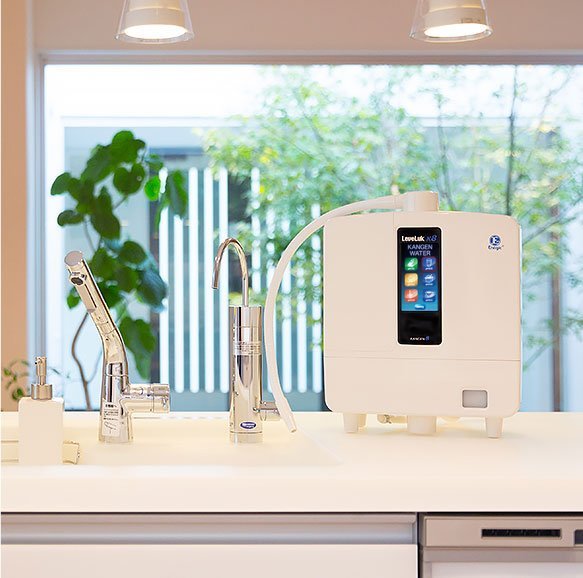
The LeveLuk K8 is the eight-plate ionizer we sell. It filters tap water and changes its pH by electrolysis as you pour. It does not structure water. Specs and documentation are on the product page.
What is structured water, in short
Structured water is ordinary water with a story attached. The story borrows from real science: hydrogen bonding, hexagonal ice, and an effect at gel surfaces. But liquid water reshuffles its structure in femtoseconds, the best-known exclusion-zone findings have a conventional chemical explanation from other labs, and no controlled trial has tested drinking it. If a device is sold on structure alone, you are paying for the story. Find out what is in your water first.
This article is for general information and is not medical advice. Talk to your doctor before changing what you drink, especially if you have kidney disease, are pregnant, or take medication.
Before you go
Get the next honest answer by email
We'd rather tell you when the answer is no. One email a week, written the same way as this post.