
Nitrates in water test: who needs one, and how to read the result without a units error
We sell water ionizers, and an ionizer is not a nitrate filter or a water test, so nothing in this guide ends with a reason to buy one from us. We would rather say that in the first line than bury it.
A nitrates in water test is one of the simplest tests a household can run, and one of the easiest to misread. Nitrate has no taste, smell, or color, so the test is the only way to know it is there. The trap is the units: the same water can be reported as 10 or as 44, depending on how the lab or kit writes the result. Below: who needs to test, how to read the number, and what the agencies say to do if it is high.
Who needs a nitrates in water test

If you are on a public water system, someone is already testing for you. The Minnesota Department of Health notes that public systems test for nitrate “at least once a year.” Your utility’s annual water quality report lists the result, and our guide to whether your tap water is safe to drink explains how to read that report. A nitrate violation is also one of the few problems that triggers the fastest federal notice. Under 40 CFR 141.202, it is a Tier 1 violation, and the system must notify customers “no later than 24 hours” after it learns of it, by broadcast media, posting, hand delivery, or another approved method.
If you are on a private well, nobody is testing for you. Federal drinking water rules do not cover private wells, and the EPA lists fertilizers, human sewage, and animal waste as the sources that reach them “through groundwater movement and surface water seepage and water run-off.” The Minnesota Department of Health’s advice for well owners is to “test for nitrate every year,” and to test before bringing a new baby home. Its well page lists the wells most at risk: shallow wells, wells in sand, karst, or fractured rock, dug wells whose casings are not watertight, and wells with damaged casings or fittings.
The units trap: “as N” versus “as NO3”
The EPA’s drinking water standard for nitrate is 10 mg/L, “measured as Nitrogen.” That means the lab counts only the nitrogen atom in each nitrate ion. But nitrate (NO3) is one nitrogen atom plus three oxygen atoms, and many test kits and some lab reports give the weight of the whole ion instead. Same water, different number.
The conversion comes straight from the atomic weights:
- Nitrogen weighs about 14.0. Nitrate (NO3) weighs about 62.0 (14.0 + 3 × 16.0).
- 62.0 ÷ 14.0 ≈ 4.43.
- So 10 mg/L nitrate as N is about 44 mg/L nitrate as NO3. Some utilities round it to 45.
That means a kit reading 30 mg/L “as NO3” is below the federal limit (about 6.8 as N). A reading of 30 “as N” is three times over it. If your report or kit does not say which unit it uses, find out before comparing the number with anything. Central Iowa Water Works gives home testers the same warning: the two units “are not interchangeable.”
Nitrite, the closely related compound, has its own and lower limit: 1 mg/L, also measured as nitrogen. By the same arithmetic (NO2 weighs about 46.0), that is about 3.3 mg/L as NO2.
Strips, kits, and a certified lab
Home strips are cheap and quick, and the best evidence on them says to treat them as a screen, not a verdict. In a 2008 field study (Searles Nielsen and colleagues, Journal of Exposure Science and Environmental Epidemiology), residents of 102 Washington homes tested their own tap water with a nitrate/nitrite strip and sent a matching sample to a lab. This was a measurement comparison in real homes, not a health study. What it found:
- Strip and lab results agreed only moderately (a correlation of 0.72).
- Among the samples that contained nitrate, the lab found more than the strip did 81% of the time. In other words, strips tended to read low.
- 7% of participants had trouble telling the color blocks apart.
- The lab found no nitrite in any sample, but 5% of participants read some nitrite on the strip.
The authors concluded that strips are best used “as a screening tool or when laboratory assays are not feasible.” Central Iowa Water Works adds practical advice: follow the timing exactly, check the expiry date, read colors in good light, and pick a strip whose range clearly covers the 10 mg/L line.
For the result you act on, use a certified lab. The Minnesota Department of Health recommends an accredited lab and says to get the sample bottle and instructions from the lab itself. Timing matters too: one test maker’s method notes say to analyze nitrate samples promptly or keep them at or below 6°C (42.8°F) for a maximum of 48 hours, unless the lab supplies a preserved bottle. Ask your lab what its limit is before you collect. Our guide on how to check lead in water covers choosing a certified lab.
One test that will not help: a TDS meter. As we explain in what TDS in water measures, it reads all dissolved ions together and cannot single out nitrate.
Honest answers, weekly
The research, without the sales pitch
One short email a week: what a study actually found, what it didn't, and what's worth your attention. No spam. Unsubscribe anytime.
Reading your nitrates in water test result
Once you know the unit, the Minnesota Department of Health gives you a rough scale (all figures here are as N):
- Below 1 mg/L: typical of groundwater with no nearby source. Natural levels in Minnesota groundwater are “usually quite low (less than 1 milligrams per liter).”
- Above 1 mg/L: worth a closer look. The department says this “suggests that additional testing may be a good idea,” because “if nitrate is present, then other contaminants such as pesticides may be as well.”
- Around 3 mg/L: still under the federal limit, but the department says it “suggests human-made sources of nitrate may have contaminated the water, and the level could increase over time.” Keep testing every year, and look at what is near the well.
- Above 10 mg/L: over the federal limit. See the next section.
If a strip says you are over the limit, the next step is a lab test, not a treatment purchase.
If your result is over the limit
The health concern the federal limit is built around is infants. The EPA’s own wording: “Infants below the age of six months who drink water containing nitrate in excess of the MCL could become seriously ill and, if untreated, may die. Symptoms include shortness of breath and blue-baby syndrome.” Questions about anyone’s health belong with a doctor.
For a well over 10 mg/L, the Minnesota Department of Health’s steps are:
- Use a safe alternative source, such as bottled water, especially if babies under six months drink formula made with the water.
- Make sure babies under six months old do not drink the well water.
- Do not boil it. In the department’s words: “Do not try to boil nitrate out of the water. Boiling will make nitrate more concentrated.”
- Have a licensed well contractor inspect the well, and find and remove nitrate sources on the property.
Home treatment is an option, but the department suggests it only after the sources and the well itself have been dealt with. Even with treatment, it recommends that babies under six months not drink the treated water, in case the system fails. If you shop for a system, check the certification. As of November 25, 2026, the NSF’s certified-product search lists “Nitrate/Nitrite Reduction” only under NSF/ANSI 58, the reverse osmosis standard. Our guide to fluoride water filters shows how to confirm that a specific model holds the claim, not just its standard. Then retest the treated water.
Once your water is tested
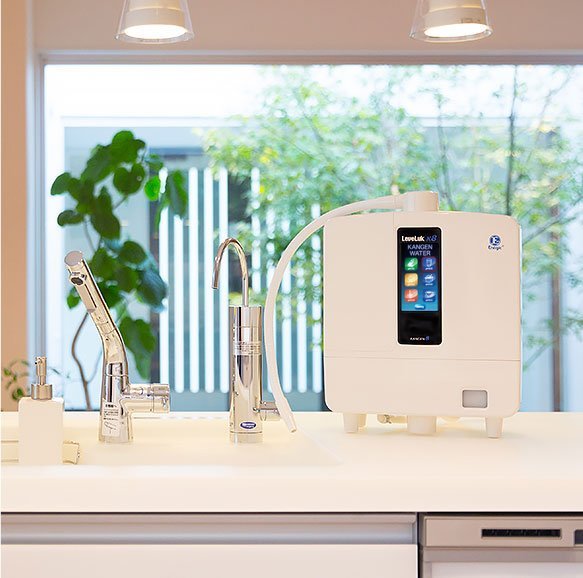
The LeveLuk K8 is the eight-plate water ionizer we sell. It is not a nitrate filter and its listing makes no nitrate-reduction claim, so do not buy it for a nitrate problem. Specs are on the product page.
The bottom line on a nitrates in water test
On city water, read your utility’s annual report; a nitrate violation also brings a notice within 24 hours. On a private well, test every year with a certified lab, and before a baby arrives. Before you compare any number with the limit, check the unit: 10 mg/L as N and about 44 mg/L as NO3 are the same line. Treat a strip as a screen that tends to read low, and confirm anything worrying with a lab. Above the limit, do not boil the water, give infants another source, and deal with the well before you buy treatment.
This article is for general information and is not medical advice. Regulatory and certification references are current as of November 25, 2026, and may change. For questions about your well, contact your state or county health department or a licensed water professional. For city water, contact your utility.
Before you go
Get the next honest answer by email
We'd rather tell you when the answer is no. One email a week, written the same way as this post.