Arsenic in water test: which tests can see the limit, and what to ask a filter seller
We sell water ionizers, and an ionizer is not an arsenic filter or an arsenic test, so nothing in this guide ends with a reason to buy one from us. We would rather say that in the first line than bury it.
An arsenic in water test is the only way to know whether arsenic is in your water, because you cannot see, taste, or smell it. The harder question is which test can actually tell you where you stand against the US limit, which is a very small number. Below: who needs to test, what the limit is, why a home kit and a certified lab are not interchangeable, and the question to ask before you buy any filter that says it “removes arsenic.”
Why an arsenic in water test is the only way to know

The EPA describes arsenic as “odorless and tasteless,” and it can enter water from natural deposits in the earth or from farming and industry. The Minnesota Department of Health adds a point that matters for well owners: there is no way to know a well’s arsenic level before it is drilled, and levels “can vary between wells, even within a small area.” Your neighbor’s result does not tell you yours.
On a public water system, your utility tests for arsenic and must meet the federal limit. Its annual water quality report lists the result, and our guide to whether your tap water is safe to drink shows how to read that report.
On a private well, nobody tests for you. The US Geological Survey puts it plainly: maintenance, testing, and treatment of private water supplies are “the sole responsibility of the homeowner.” Minnesota’s health department recommends testing for arsenic at least once, with an accredited laboratory, and once more for a new well beyond its first test. A TDS meter will not help here either. The arsenic limit is a hundredth of one milligram per liter, and TDS lumps all dissolved solids into one number without saying which ones. Our guide to what TDS measures explains why.
The number to compare against
The EPA’s National Primary Drinking Water Regulations set the arsenic limit for public water at 0.010 mg/L, in force “as of 01/23/06.” The health-based goal behind it is zero. The same table lists the potential health effects of long-term exposure above the limit, and we would rather point you to the agency’s own wording than paraphrase it.
The units trip people up, so here is the conversion in one place:
- 0.010 mg/L = 10 µg/L (micrograms per liter) = 10 ppb (parts per billion).
- Lab reports may use any of the three. Convert before you compare.
Two caveats. First, the federal limit applies to public water systems, not private wells. It is still the benchmark most agencies tell well owners to use. Second, a state can set a stricter line. New Hampshire’s environmental agency, in a fact sheet dated March 2021, says the state set its own limit at 5 ppb, effective July 2021. Check your state’s health or environmental agency for the number that applies where you live.
Home arsenic test kits vs. a certified lab
The common home arsenic kits evaluated in published studies work the same basic way: the reagents turn arsenic in the sample into a gas that stains a test strip, and you match the color against a printed chart. That means the result is a color step, not a measurement. One kit evaluated in a 2012 study had chart steps of 0, 10, 25, 50, and up. With a limit of 10, the step that matters is the one you are least likely to read cleanly.
Two published field evaluations, both comparing kits with laboratory measurements of the same water, show what that looks like in practice:
- Nevada, 136 water sources (Steinmaus and colleagues, 2006). Two kits landed in the same concentration band as the lab 71% and 62% of the time, and within one band almost always. Both flagged every sample above 15 µg/L as over the limit.
- Bangladesh, 123 wells (George and colleagues, 2012). One kit sorted 89% of wells correctly against 10 µg/L. Every one of its misses was an underestimate, for wells between 10 and 27 µg/L.
The honest reading: a kit can tell you that water is clearly high. It is weakest in exactly the zone a household cares about, just above the limit, and its errors there tend to fall on the reassuring side. A lab result is a number. Minnesota’s health department notes that for new-well testing, the detection level for arsenic “is usually 2 µg/L,” well below the limit.
To find a lab, the EPA’s lab-certification page links each state’s program. The EPA does not test home water itself. Our guide to checking for lead in water walks through how the lab, the bottle, and the sampling instructions work, and the same process applies here.
Honest answers, weekly
The research, without the sales pitch
One short email a week: what a study actually found, what it didn't, and what's worth your attention. No spam. Unsubscribe anytime.
How to take the sample and read the report
How the sample is collected changes the number. A 2018 USGS and Minnesota study found arsenic results were most reliable when samples were filtered, taken from household plumbing rather than the drill rig’s pump, or taken several months after the well was built. Sediment in the bottle made results less consistent. In practice: follow the lab’s bottle instructions exactly, and if a new well shows any arsenic, Minnesota suggests retesting about six months after construction.
When the report arrives, check three things.
The unit
Convert to µg/L (ppb) before comparing with 10. A result of 0.008 mg/L is 8 ppb.
Total arsenic
A standard test reports total arsenic, the form the limit is written for. That is the number to compare.
The form, if you are choosing treatment
Arsenic in well water comes in two inorganic forms, arsenic III and arsenic V. New Hampshire’s fact sheet explains why the difference matters: arsenic V carries a negative charge and is “more easily removed,” while arsenic III has no charge. If your result is elevated, ask the lab whether it offers a test for the form (often called speciation) before you choose treatment. New Hampshire recommends that follow-up above 5 ppb.
If your arsenic in water test comes back over 10 ppb
Start with what does not work. Minnesota’s health department says boiling “will only concentrate the arsenic,” because some of the water evaporates. It also says conventional water softeners and activated carbon filters will not remove arsenic on their own.
Then read the certification, not the box. In NSF’s certified-product database, the arsenic claims are written as “Arsenic (Pentavalent)<=50 ppb Reduction,” with a “<=300 ppb” version listed only under the reverse osmosis standard (as of November 26, 2026). Two words in that name do the work:
- Pentavalent means arsenic V. The claim does not say the unit handles arsenic III. New Hampshire notes that reverse osmosis removes about 60% of arsenic III, compared with 95% of arsenic V, and recommends a pre-oxidation step when arsenic III is present. Chlorine, ozone, permanganate, and manganese dioxide media work for that step. Air, UV light, and chlorine dioxide do not.
- <=50 ppb is the starting level the unit was tested against. New Hampshire points out that NSF-certified pitchers only have to bring arsenic from 50 ppb to below 10. If your water starts higher, the certification does not describe your situation.
Our guide to fluoride water filters shows how to confirm that a specific model, not just its standard, holds a claim. If your well also has iron, New Hampshire notes that oxidation-filtration aimed at iron can remove arsenic along with it. Our guide to iron filters for well water covers that equipment.
Whatever you install, test the treated water. New Hampshire recommends testing it quarterly in the first year and twice a year after that. Minnesota adds that if your arsenic is above 10 µg/L and you switch to bottled water, ask the bottler for its own test results, because no single set of standards covers all bottled water.
Once your water is tested
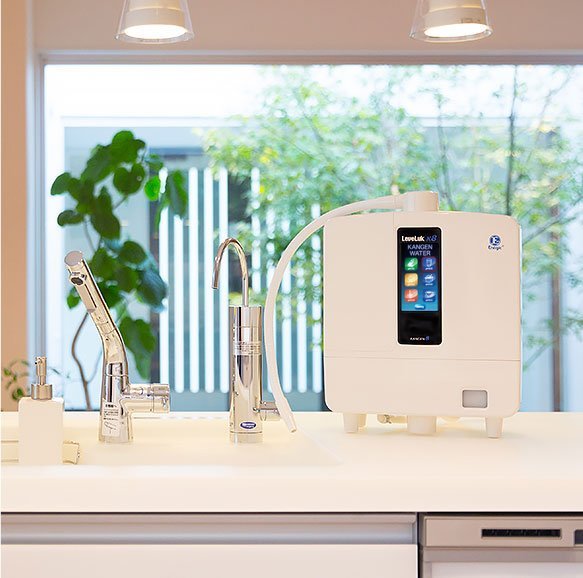
The LeveLuk K8 is the eight-plate water ionizer we sell. It is not an arsenic filter and its listing makes no arsenic-reduction claim, so do not buy it for an arsenic problem. Specs are on the product page.
The bottom line on an arsenic in water test
On city water, your utility’s annual report already has the number. On a private well, test at least once with a certified lab, because a home kit is least reliable just above the 10 ppb limit and tends to miss on the low side. Convert units before comparing. If the result is high, don’t boil the water. Ask which form of arsenic you have, and read a filter’s certification for the word “pentavalent” and the starting level. Then retest the treated water.
This article is for general information and is not medical advice. Regulatory and certification references are current as of November 26, 2026, and may change. For questions about your well, contact your state or county health department or a licensed water professional. For city water, contact your utility.
Before you go
Get the next honest answer by email
We'd rather tell you when the answer is no. One email a week, written the same way as this post.