What is TDS in water? What the number measures, and why it isn’t a safety score
We sell water ionizers, so we have a commercial interest in how people think about their water. Weigh what follows with that in mind. We would rather say it in the first line than bury it at the bottom.
What is TDS in water? TDS stands for total dissolved solids: the combined weight of everything dissolved in a sample of water that isn’t water itself, usually given in milligrams per liter (mg/L) or parts per million (ppm). It is a useful number, but it is a sum, not a verdict, and it is often presented as a safety score, which it isn’t. Below: what the number adds together, what the official 500 mg/L figure actually means, and what a TDS reading cannot tell you.
What is TDS in water, and what does the number add together?
The World Health Organization’s background document on total dissolved solids describes TDS as the inorganic salts and small amounts of organic matter present in solution. The main contributors are usually calcium, magnesium, sodium, and potassium, paired with bicarbonate, carbonate, chloride, sulfate, and nitrate. Ohio State University’s Ohio Watershed Network puts it more simply: the sum of the minerals, metals, and salts dissolved in the water.
Two practical notes on units. In fresh drinking water, 1 mg/L and 1 ppm are effectively the same thing, because a liter of water weighs about a kilogram. And the natural range is wide: WHO reports levels from natural sources running from under 30 mg/L to as much as 6,000 mg/L, depending on local geology.
The key word is total. A TDS figure tells you how much is dissolved. It does not tell you what. Water at 300 mg/L could be almost entirely calcium and bicarbonate picked up from limestone, or it could include something you would want to know about. The number is identical either way.
What the 500 mg/L figure means, and what it doesn’t
Most articles on this topic quote 500 mg/L as the limit. It comes from the U.S. Environmental Protection Agency, but it is a secondary standard, and the EPA is explicit about what that means. Secondary standards are non-mandatory, the EPA does not enforce them, and they exist to help water systems manage taste, color, and odor. The agency states that these contaminants are not considered a risk to human health at that level. For TDS, the effects it lists above 500 mg/L are hardness, deposits, colored water, staining, and a salty taste.
Federal bottled-water rules draw the same line. Under 21 CFR 165.110, bottled water generally may not exceed 500 mg/L of TDS, but mineral water is exempt, and the regulation notes that these exemptions are aesthetically based and “do not relate to a health concern.”
The other figure you will see everywhere is a scale running from “excellent” to “unacceptable,” usually credited to WHO. It is real, but it is a taste scale. In the WHO document, panels of tasters rated water under 300 mg/L excellent, 300 to 600 good, 600 to 900 fair, 900 to 1,200 poor, and over 1,200 unacceptable. Some versions online add a lower bound of 50 mg/L that does not appear in the WHO text. WHO’s own conclusion is that reliable data on health effects from TDS in drinking water are not available, and it proposes no health-based guideline value for TDS.
Is high TDS bad? Is low TDS better?
It depends entirely on what the solids are. High TDS from calcium and magnesium is hard water. WHO notes that levels above 500 mg/L cause excessive scaling in pipes, water heaters, and kettles, and you will see it as spots on glassware. That is a nuisance, not a health finding on its own.
Ohio State adds the caveat that matters: high TDS may indicate elevated levels of ions that do pose a health concern, such as arsenic, copper, lead, or nitrate. The same page notes that people unaccustomed to high-TDS water may get gastrointestinal irritation. So a high reading is a reason to find out what is in the water, not a diagnosis.
Low TDS is not automatically better either. Purified and distilled waters sit near zero by design. WHO notes that very low TDS water can taste flat and insipid and tends to be corrosive to plumbing. Whether that matters for drinking is a separate question, covered in our comparison of alkaline, spring, purified, and distilled water. “Lower is purer, and purer is healthier” is a marketing line, not chemistry.
What TDS can’t tell you
It can’t see the contaminants that matter at tiny doses
Substances with health-based limits are regulated at concentrations far below anything a TDS number resolves. In the EPA’s primary drinking water regulations, the legal limit for arsenic is 0.010 mg/L, and the health goal for lead is zero (lead is regulated by a treatment technique with an action level of 0.015 mg/L). WHO puts the practical quantitation limit of the usual TDS method at 10 mg/L, a thousand times the arsenic limit. A “good” TDS reading does not mean those are absent, and a “bad” one does not mean they are present.
It mostly sees charged particles
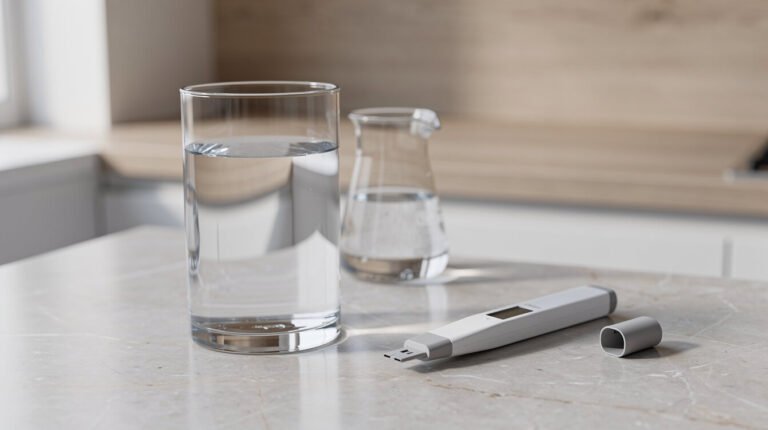
TDS is usually measured indirectly. WHO describes the common method as measuring electrical conductivity with a probe that detects ions, then converting that to TDS with a factor that varies by type of water. Handheld meters work on the same principle. Substances that don’t carry a charge, including many organic chemicals, barely register.
It isn’t pH, and it isn’t hydrogen
TDS and pH are separate properties. Two waters with the same TDS can have different pH. If pH is your question, see how to test water pH at home. Dissolved molecular hydrogen (H2), the gas that electrolysis produces, is not an ion, so a conductivity-based TDS reading says nothing about it. Our post on molecular hydrogen water covers how H2 is actually measured.
Honest answers, weekly
The research, without the sales pitch
One short email a week: what a study actually found, what it didn't, and what's worth your attention. No spam. Unsubscribe anytime.
What a typical TDS reading looks like for different waters

When people ask what is TDS in water from different sources, the honest answer is a range. Use these as orientation, not targets.
- Tap water. This depends on local geology and treatment. As one example, Ohio State lists a typical Ohio range of 290 to 830 mg/L, with higher values in northwestern Ohio’s bedrock aquifers. Your utility’s numbers are in its Consumer Confidence Report, which you can look up through the EPA’s CCR page.
- Mineral water. At least 250 ppm by its federal definition, from a protected underground source, with no minerals added. Labels must say “low mineral content” below 500 ppm and “high mineral content” above 1,500 ppm.
- Spring water. Whatever its source contributes. The federal definition sets no TDS requirement. Our post on what spring water actually contains covers the mineral side.
- Purified, distilled, and reverse osmosis water. Near zero by design. Ohio State lists reverse osmosis, distillation, and electrodialysis among the treatments that remove TDS.
When a TDS reading isn’t enough
A TDS number is a fine screening tool for taste, scale, and whether your water has changed since the last time you checked it. It is the wrong tool for a safety question. Get a proper laboratory analysis, from a state-certified lab, if any of these apply:
- You use a private well. Your local utility’s report doesn’t cover it.
- Your home has older plumbing and lead is a possibility.
- You are preparing infant formula. The EPA warns that infants under six months who drink water with nitrate above the legal limit can become seriously ill, and TDS will not single nitrate out.
- You are on a sodium-restricted diet, or have kidney disease and have been told to watch minerals. TDS doesn’t say how much of the total is sodium, potassium, or magnesium. A 2001 comparison of published mineral data (Azoulay et al., J Gen Intern Med) found that high-mineralization bottled waters often contained up to half the maximum recommended daily sodium intake. Ask your doctor what your limits are, and read the individual figures, not the total.
- The reading changes sharply with no obvious reason.
If you are comparing waters
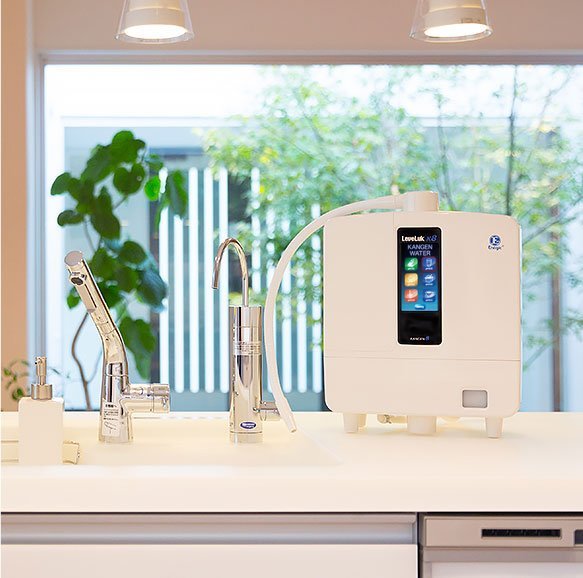
The LeveLuk K8 is the eight-plate ionizer we sell. It filters your tap water and adjusts pH by electrolysis as you pour. We don’t claim it changes your TDS reading, and it is not a substitute for a lab test. Specs and documentation are on the product page.
So, what is TDS in water good for?
TDS is a quick, cheap measure of how much is dissolved in your water. It is good at predicting taste and scale, and at telling you whether something has changed. It is not a safety score. The 500 mg/L figure is an aesthetic guideline the EPA doesn’t enforce, the “excellent to unacceptable” scale is a taste panel, and the contaminants with real health limits sit far below what the number can see.
If the reading surprises you, find out what the solids are rather than chasing a lower number. That means a lab test or your utility’s report.
This article is for general information and is not medical advice. Talk to your doctor before changing what you drink, especially if you have kidney disease, are pregnant, or take medication.
Before you go
Get the next honest answer by email
We'd rather tell you when the answer is no. One email a week, written the same way as this post.