Filter for iron in well water: how to choose one without being sold one
We sell water ionizers, and an ionizer is not an iron filter, so nothing in this guide ends with a reason to buy one from us. We would rather say that in the first line than bury it.
Choosing a filter for iron in well water is harder than the listings make it look. Most “best iron filter” pages rank equipment without knowing your water, and that is the problem: whether an iron filter works depends less on the brand than on the form of iron you have, your water’s pH, and what else is in the well. Below: the main treatment types, the chemistry that decides between them, and what to ask before you buy.
Start with the test, not the filter
The Minnesota Department of Health puts it plainly: treating iron “depends on the form(s) of iron present, the chemistry of the water, and the type of well and water system.” North Dakota State University Extension makes the same point from the other direction, saying a water test before installing any treatment system “is important” because its interpretation helps decide “what type of system or systems to consider.”
So the lab report comes first. Ask for iron, manganese, hardness, pH, and alkalinity, and mention any slime or rotten-egg smell. Our guide to the iron in water test covers how to take the sample and which kits read which form of iron, so we won’t repeat it here. One number to keep in proportion: the EPA’s 0.3 mg/L for iron is a secondary standard for “rusty color; sediment; metallic taste; reddish or orange staining,” not a health limit. Treating it is about stains, taste, and equipment wear.
The main types of filter for iron in well water

The concentration ranges below come from Minnesota’s health department and NDSU. The exact limit for any unit is whatever its manufacturer rates it for.
- Water softener (ion exchange). NDSU explains that dissolved iron can be “exchanged for sodium on an exchange resin,” the same process that removes calcium and magnesium. It works on clear-water (dissolved) iron. Minnesota notes that some manufacturers report up to 10 mg/L, but “2 to 5 mg/L is a more common limit.”
- Oxidizing media filter. The classic example is manganese greensand, which pulls dissolved iron out of the water and turns it into particles that are flushed out by backwashing. The media is periodically regenerated with potassium permanganate. NDSU says most are rated up to 10 mg/L, and Minnesota gives 10 to 15 mg/L.
- Aeration or chemical oxidation, then filtration. Air, chlorine, or hydrogen peroxide converts the iron to particles, and a filter catches them. NDSU calls this “the accepted method” above 10 mg/L and says chlorine needs about 20 minutes of contact time to form particles that can be filtered. Minnesota warns that dosing chemicals “can be difficult and carries health risks if improperly dosed.” With chlorine, organic matter in the water can also form trihalomethanes, a regulated disinfection byproduct.
- Sequestering (polyphosphate). This doesn’t remove iron at all. It keeps the iron in solution so it doesn’t stain. NDSU says it won’t remove the metallic taste and shouldn’t be used above 2 mg/L of iron, or 3 mg/L of iron and manganese combined.
- Point-of-use reverse osmosis or distillation. Minnesota says these “can remove any type of iron,” but a lot of iron “can quickly plug up the units.”
Sediment and carbon filters catch small amounts of red-water iron, but Minnesota notes it “will quickly plug the system.”
Why your water chemistry decides which one works
Most buying guides skip this, and it is why one filter works in one well and fails in the next.
The form of iron
Clear-water (ferrous) iron suits a softener or an oxidizing media filter. Red-water (ferric) iron is already particles, so it is mainly a filtration job; a softener can catch small amounts, but NDSU notes that particles plug the resin. Organic iron and tannins are the hard case: Minnesota says they “can slow or prevent iron oxidation,” so softeners, aeration, and iron filters “may not work well,” and chemical oxidation followed by filtration may be the option.
pH
NDSU says that if the water’s pH is below 6.8, a greensand filter “will probably not filter out the iron and manganese adequately,” and that calcite pretreatment can raise it above 7.0. Chlorine oxidizes iron best at a pH of about 8.0. A seller who recommends a system without asking for your pH is guessing.
Manganese, hydrogen sulfide, and iron bacteria
Manganese often travels with iron and has its own EPA secondary standard of 0.05 mg/L, with black rather than orange stains. NDSU notes that hydrogen sulfide, the rotten-egg smell, is “frequently” present alongside iron and manganese. Iron bacteria leave a red or brown slime and, per NDSU, make iron problems in a softener worse. NDSU says shock chlorination of the well and household plumbing is needed to remove them, which a bigger filter won’t do.
Air and plumbing
Minnesota says a softener is less effective when hardness is low and iron is high, or when the system lets the water contact air, as in an air-charged galvanized pressure tank. And if the iron comes from corroding galvanized pipes rather than the aquifer, NDSU suggests that the fix may be the pipe material, not a filter.
Honest answers, weekly
The research, without the sales pitch
One short email a week: what a study actually found, what it didn't, and what's worth your attention. No spam. Unsubscribe anytime.
What to ask before you buy a filter for iron in well water
For fluoride, you can check a certified claim in NSF’s public listing. Iron is different. As of November 24, 2026, the claim options in NSF’s certified-product search include no iron reduction claim, and the softener standard (NSF/ANSI 44) offers hardness, barium, and radium reduction claims. An iron capacity figure you are quoted is therefore most likely the manufacturer’s own rating. That doesn’t make it wrong, but know whose number it is.
- What is it rated for, and under what conditions? Ask for the maximum iron level in writing, and whether it assumes a particular pH, manganese level, or form of iron.
- Can my well pump handle the backwash? NDSU says backwashing often needs flow rates “three to four times the normal household usage rate,” and if the system can’t supply it, “poor filter performance and failure are likely.” You also need somewhere to send the backwash water.
- What does it consume? Salt, potassium permanganate, chlorine, or replacement media, how often, and who handles the chemicals.
- Who installs it? Minnesota recommends a licensed plumber or licensed water conditioning contractor. Check what your state requires.
- Will you retest after installation? A raw sample and a treated sample, taken the same day, is the simplest way to know it is working.
One caution on softeners: because they exchange iron and hardness for sodium, anyone in the house on a sodium-restricted diet should ask their doctor before drinking softened water, or keep one unsoftened tap for drinking.
When a whole-house iron filter is more than you need
- Your result is under 0.3 mg/L and nothing is staining. There is no iron problem to treat.
- You are on city water. Sudden rusty water is a call to the utility, not a reason to buy equipment. Our guide to whether your tap water is safe covers how to read your utility’s annual report.
- The iron is coming from your pipes. If a sample taken near the well is clean but the kitchen tap isn’t, look at the plumbing first.
- The only issue is mild staining. Below 2 mg/L, NDSU describes polyphosphate as a relatively inexpensive option, as long as you accept that the iron and its taste stay in the water.
- You only care about drinking water. A point-of-use unit at one tap may be enough, provided the iron level won’t plug it.
If a demonstration in your kitchen is the main evidence for buying something, ask for the lab numbers instead. That applies to our products too.
After the iron is sorted
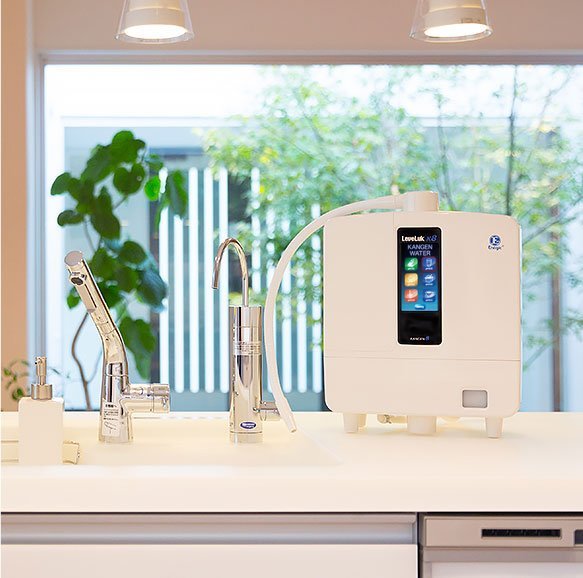
The LeveLuk K8 is the eight-plate water ionizer we sell. It is not an iron filter and its listing makes no iron-reduction claim, so do not buy it for an iron problem. Specs are on the product page.
The bottom line on choosing a filter for iron in well water
Test first, with iron, manganese, pH, and hardness in one report. Then match the treatment to the iron: a softener for modest clear-water iron in hard water, an oxidizing media filter for higher levels at a pH above about 6.8, and oxidation plus filtration for the highest levels or organic iron. Get any iron rating in writing, knowing it is probably the maker’s own number, and retest once the system is in. No list of “best” iron filters has seen your lab report.
This article is for general information and is not medical advice. Regulatory and certification references are current as of November 24, 2026, and may change. For questions about your well, contact your state or county health department or a licensed water professional. For city water, contact your utility.
Before you go
Get the next honest answer by email
We'd rather tell you when the answer is no. One email a week, written the same way as this post.