TDS water tester: how to use one, what the reading means, and what it can’t detect
We sell water ionizers, so we have a commercial interest in how people think about their water. Weigh what follows with that in mind. We would rather say it in the first line than bury it at the bottom.
A TDS water tester is one of the simplest water tools you can buy, and one of the most misread. People search “is 70 TDS water safe,” buy a pen, dip it in a glass, and treat the number as a grade. It isn’t one. A TDS water tester estimates how much dissolved, electrically charged material is in a sample, which makes it good for a few jobs and useless for others. Below: how it works, how to take a reading worth comparing, and what it can and can’t do. We cover what TDS itself means in our post on what TDS in water measures, so here we stick to the meter.
What a TDS water tester actually measures
The pen doesn’t weigh anything. Culligan, which sells water testing and treatment, describes it plainly: the meter passes a small electrical current through the water, measures how well the water conducts it, and converts that into an estimated TDS figure. The same article notes that the most accurate way to measure dissolved solids is to evaporate the water and weigh what’s left, which is a lab job.
Conductivity works as a stand-in because dissolved salts split into charged particles (ions), and ions carry current. More ions, more conductivity. But the conversion from conductivity to parts per million (ppm) depends on which ions are present. Ohio State University’s Ohio Watershed Network gives a rule of thumb: divide the specific conductivity reading by 1.5 to get approximate TDS. A pen that displays ppm has to assume a ratio like that, and your water may not match it.
Temperature matters too. The U.S. Geological Survey’s field manual on specific conductance says conductivity rises by 0.5 to 3 percent per degree Celsius, depending on the ions present, which is why meters correct readings to a standard 25 °C. That correction is itself an approximation.
How to take a TDS water tester reading you can trust
The goal is a number you can compare with the next one. A few habits do most of the work:
- Use a clean glass, because soap residue adds ions.
- Rinse with the sample first. The USGS procedure rinses the container and probe with the water being tested, discards it, measures a fresh pour, and repeats on at least two fresh subsamples.
- Immerse only as deep as the manual says. One retailer’s instructions for its pen say about half an inch is plenty, and that submerging it too deeply will ruin the meter.
- Wait for the number to settle, and compare samples at the same temperature.
- Check it against a standard occasionally, if your meter allows calibration. USGS calibrates field meters against standard solutions of known conductivity. Some pens are sold as factory-calibrated with no user adjustment.
How accurate can it be? USGS says modern field-grade conductance meters are typically accurate to within ±5 percent for water between pH 4 and 11 and between 5 and 35 °C. A pocket pen’s tolerance is whatever its manual states.
What your number means, and what a TDS meter can’t see
The short version, covered in depth in our TDS explainer: the 500 mg/L figure quoted everywhere is an EPA secondary standard for taste and appearance. It is not enforced and is not a health limit. So “is 70 TDS water safe?” can’t be answered from the number. 70 ppm of mostly calcium and bicarbonate and 70 ppm that includes something harmful look identical on the display.
A TDS meter also misses most of what matters for safety. Culligan’s list of things a TDS tester won’t tell you includes lead, copper, iron, chlorine, hydrogen sulfide, and bacteria. Lead is regulated at concentrations far too small to stand out in a total, bacteria aren’t dissolved ions, and uncharged substances barely register.
The two jobs a TDS meter does well

Checking a reverse osmosis membrane
This is the job a TDS water tester is best at. Reverse osmosis is designed to remove dissolved solids, so comparing tap water with RO output tells you whether the membrane is still doing that. Pure Water Products, an RO retailer, gives a rule of thumb: the RO water should read about one tenth or less of the tap reading. Tap at 250 ppm, RO at around 25 or less. That’s their guideline, not a standard. A ratio that drifts upward over months means the membrane is passing more through.
Two cautions from the same source. A new system needs a few days of running before the reading is reliable. And test before you change carbon filters, because new carbon filters can push the reading up for a while.
Spotting change over time
The second good use is as a baseline. Read your tap water a few times under the same conditions, note the number, and check it now and then. A sudden large jump with no explanation is a reason to find out what changed. The meter can’t tell you what, only that something did.
One thing it is not good for is judging a carbon filter. Ohio State notes that removing excess dissolved solids takes relatively expensive treatment such as reverse osmosis. A carbon filter is a different technology, so a similar reading before and after one doesn’t, by itself, mean the filter failed.
Honest answers, weekly
The research, without the sales pitch
One short email a week: what a study actually found, what it didn't, and what's worth your attention. No spam. Unsubscribe anytime.
If someone uses a TDS meter to sell you something
In a 2019 piece for the trade magazine Water Conditioning & Purification, Kelly Thompson, whose company trains water salespeople and sells test kits, separates tests (hardness, iron, pH, TDS), which give quantifiable results, from demonstrations, which make results feel relatable. He singles out the precipitation demo, where hard water forms a sludge in a test tube: a legitimate picture of what happens in a water heater that “has nothing to do with whether the water is safe or unsafe,” though salespeople often fail to correct that impression.
The same logic applies to a TDS meter. A high reading on your tap water next to a near-zero reading on a seller’s filtered sample shows that their filter removes dissolved ions. It doesn’t show that your water is dangerous. Some sellers go further and run a current through a glass of tap water with metal electrodes until it clouds or changes color. That reaction depends on dissolved ions too, and it says nothing about contamination. If a demonstration is doing the persuading, ask for a lab report instead.
We sell water ionizers, so this applies to us as well. A TDS reading is not a reason to buy one.
TDS meters and water ionizers
If you own an ionizer, or are considering one, know what a TDS meter can’t tell you about it. It doesn’t measure pH. That needs a strip, a drop kit, or a pH meter, covered in how to test water pH at home. It doesn’t measure dissolved molecular hydrogen (H2) either. H2 is an uncharged gas, so it adds essentially nothing to conductivity. Our post on molecular hydrogen water explains how H2 is actually measured.
Readings on an ionizer’s strongest settings are also less reliable. USGS notes that in very acidic water (below pH 4), standard temperature compensation can be off by as much as 50 percent, because hydrogen ions conduct electricity differently from most other ions. It also notes that no temperature-compensation method exists for water above pH 11. Where a TDS meter is useful to an ionizer owner is on the source water: what’s coming into the machine, and whether it has changed.
If you are weighing an ionizer
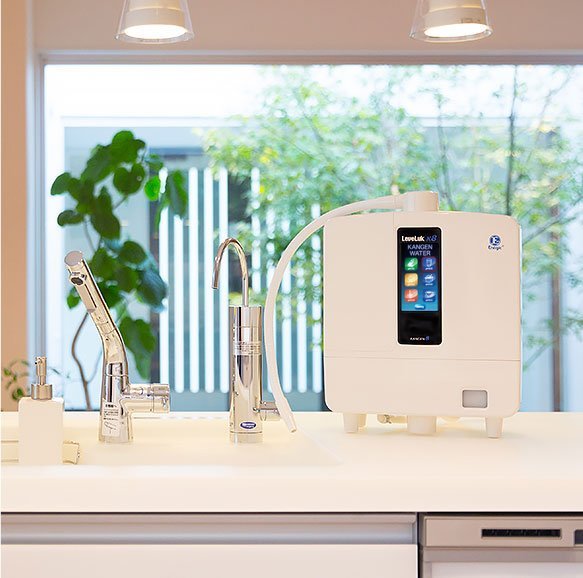
The LeveLuk K8 is the eight-plate ionizer we sell. It filters tap water and adjusts pH by electrolysis as you pour. A TDS meter can’t evaluate what it does, because it reads neither pH nor dissolved hydrogen. Specs and documentation are on the product page.
When to skip the TDS water tester and get a lab test
A TDS water tester answers “how much is dissolved, and has it changed?” For a safety question, you need a lab analysis from a state-certified laboratory, or your utility’s annual water quality report. Get one if you use a private well, if your home has older plumbing and lead is possible, if you prepare infant formula with tap water, or if your reading jumps sharply for no obvious reason. If you’re weighing mineral content specifically, our post on mineral water covers what the individual minerals add.
Used for what it does well, a TDS meter is useful. Used as a safety verdict, it gives false reassurance and false alarms alike.
This article is for general information and is not medical advice. Talk to your doctor before changing what you drink, especially if you have kidney disease, are pregnant, or take medication.
Before you go
Get the next honest answer by email
We'd rather tell you when the answer is no. One email a week, written the same way as this post.