
Is mineral water good for you? What the minerals add, and what the label leaves out
We sell water ionizers, so we have a commercial interest in how people think about their water. Weigh what follows with that in mind. We would rather say it in the first line than bury it at the bottom.
Is mineral water good for you? It can be a real source of calcium and magnesium, and it can also be a real source of sodium. Which one you get depends on the bottle, and the label tells you. “Mineral water” is a legal category defined by how much is dissolved in it, not a health standard, and two mineral waters can differ by a factor of ten in what they contain. Below: what the term means, how much a liter can actually supply, whether your body absorbs it, and who should read the label before anyone else.
Some articles on this question go further and list effects on cholesterol, digestion, or bones. Those are health outcomes, and we are not going to claim them here. This post sticks to what the water contains and what the body absorbs, which is where the evidence is solid.
Is mineral water good for you? Start with what the label means
In the United States, the term is defined by the FDA’s bottled water standard, 21 CFR 165.110. To be called mineral water, the water must contain not less than 250 parts per million (ppm) of total dissolved solids, come from a “geologically and physically protected underground water source,” and keep a constant level and proportion of minerals at the source. The rule also says: “No minerals may be added to this water.”
Two things follow from that. First, the definition sets a floor for how much is dissolved, not which minerals those are. A water that clears 250 ppm mostly on sodium and chloride qualifies just as well as one that clears it on calcium and bicarbonate. Second, a bottle with minerals added after the fact is not mineral water under this rule, whatever the marketing implies. We cover the TDS number itself, and the “low” and “high mineral content” label thresholds, in our post on what TDS in water measures.
How much calcium and magnesium a liter can supply

The most useful data on this comes from a 2001 comparison by Azoulay and colleagues in the Journal of General Internal Medicine. It was not a trial. The authors compared published mineral analyses from the water authorities of 21 major North American cities with published data on bottled waters, and set both against dietary reference intakes.
- Moderate-mineral European bottled waters: one liter of most of them supplied 20% to 58% of an adult’s calcium reference intake and 16% to 41% of the magnesium reference intake.
- North American tap water: for half of the tap sources examined, drinking 2 liters a day supplied 8% to 16% of the calcium reference intake and 6% to 31% of the magnesium reference intake.
The data are from 2001 and specific brands change, but the spread is the point. The NIH Office of Dietary Supplements puts the range for magnesium in water at 1 mg/L to more than 120 mg/L, depending on source and brand. For reference, the adult recommended intake is 310 to 420 mg a day for magnesium and 1,000 to 1,200 mg for calcium, according to the same office.
The arithmetic is simple once you have the label. A hypothetical water listing 200 mg/L of calcium supplies 200 mg per liter, about a fifth of a 1,000 mg daily target. A water listing 20 mg/L supplies a fiftieth. Both can legally be called mineral water.
Note also that tap water is not automatically the poor relation. Depending on where you live, it can be a meaningful mineral source too, and your utility’s annual water quality report will tell you.
Is the calcium in mineral water actually absorbed?
Yes, on the evidence available.
In a 1994 randomized crossover study, Heaney and Dowell gave 18 healthy women the same calcium load from milk and from an Italian high-calcium mineral water, using a radioactive tracer to measure absorption. The average fraction absorbed was 0.433 for milk and 0.475 for the water. A 2006 review by Heaney in the American Journal of Clinical Nutrition pooled published absorption data with unpublished results from the author’s own laboratory and concluded that the high-calcium mineral waters studied had absorbability “equal to milk calcium or slightly better.”
Read that carefully for what it does and does not say. These are small absorption studies, and they concern high-calcium waters. They show that calcium dissolved in water is taken up about as well as calcium from milk. They do not show that drinking mineral water changes any health outcome, and a low-calcium mineral water has little to absorb in the first place.
The sodium question, and who should read the label first
The same 2001 comparison that found useful calcium and magnesium also found that high-mineralization bottled waters “often contained up to half of the maximum recommended daily intake” of sodium. For context, the FDA’s Daily Value for sodium is less than 2,300 mg a day.
Read the label, and talk to your doctor before making a mineral water a daily habit, if any of these apply to you:
- You are on a sodium-restricted diet. Look for the sodium figure, not the TDS figure. A high total can be mostly sodium.
- You have chronic kidney disease or have been told to watch potassium, calcium, or magnesium. We go through the kidney cautions in our post on alkaline water and kidney health, and the same logic applies to any mineral-rich water.
- You already take calcium or magnesium supplements. Water counts toward your total intake, and supplements are where people tend to overshoot.
- You are preparing infant formula. Ask your pediatrician which water to use rather than assuming a mineral water is the better choice.
Honest answers, weekly
The research, without the sales pitch
One short email a week: what a study actually found, what it didn't, and what's worth your attention. No spam. Unsubscribe anytime.
Mineral water vs tap, spring, and purified water

Spring water has no TDS requirement under federal rules, so it may contain a lot or very little. Purified and distilled water are close to zero by design. We lay out the differences side by side in our comparison of regular, spring, purified, and distilled water.
pH is the wrong number to compare them on. The current best review of alkaline water, Alebrahim and colleagues in Frontiers in Medicine (2026), a narrative review, concluded that its modest effects are “likely driven more by mineral composition than pH alone.” That cuts against the way alkaline water, including the kind our machines make, is usually sold, and we think it is right. If your mineral water is sparkling, the carbonation lowers its pH, and we cover what that does and doesn’t mean in is sparkling water acidic.
How to read a mineral water label in 30 seconds
Most mineral waters publish an analysis on the bottle or the brand’s website. Four figures do most of the work:
- Calcium (Ca) and magnesium (Mg), in mg/L. Multiply by the liters you actually drink to see what you are getting.
- Sodium (Na), in mg/L. The figure that matters most if you have been told to limit salt.
- TDS or “dry residue.” How much is dissolved in total, never what.
- Bicarbonate (HCO₃). A measure of the water’s buffering capacity, which pH alone does not tell you.
Be aware that a nutrition panel reading “0 mg” is a rounding rule, not a measurement. We explain the rule in our breakdown of one bottled water label. For the spring-water version of this checklist, see what spring water actually contains.
If you are deciding what to drink at home
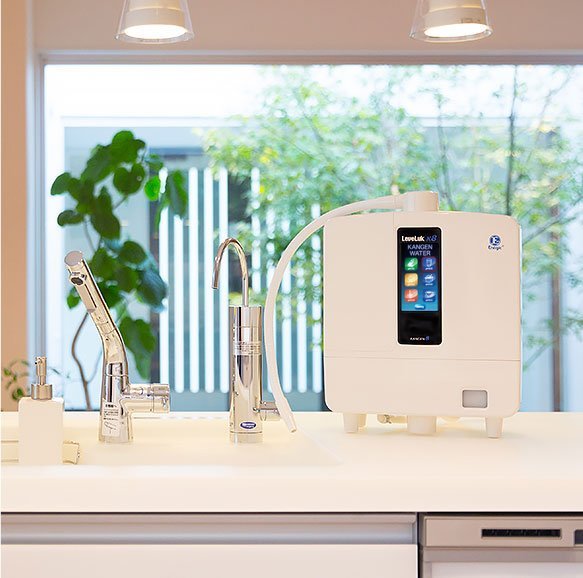
The LeveLuk K8 is the eight-plate ionizer we sell. It filters your tap water and adjusts pH by electrolysis as you pour. It does not add minerals: what ends up in the glass is what your tap water already carries, so it will not turn tap water into mineral water. Specs and documentation are on the product page.
So, is mineral water good for you?
It can be a genuinely useful source of calcium and magnesium, and the calcium in high-calcium waters is absorbed about as well as the calcium in milk. That is a nutrient fact, not a health claim, and it only holds for waters that actually contain much calcium. The same bottle can carry a meaningful share of a day’s sodium, which matters if you have been told to limit it.
So the honest answer to “is mineral water good for you” is that it depends on the label and on you. Read the calcium, magnesium, and sodium figures, multiply by what you drink, and ask your doctor if you have kidney disease or a sodium limit.
This article is for general information and is not medical advice. Talk to your doctor before changing what you drink, especially if you have kidney disease, are pregnant, or take medication.
Before you go
Get the next honest answer by email
We'd rather tell you when the answer is no. One email a week, written the same way as this post.